
Lymphatic Health
What Is the
Lymphatic System?
The lymphatic system is an extensive network of vessels, lymph nodes, organs, and tissues working throughout the body.
Unlike the cardiovascular system, it does not have a central pump like the heart. Lymph movement is supported by the lymphatic vessels themselves, along with everyday movement, muscle activity, breathing, and changes in pressure within the body.
Fluid Balance
Helps return excess tissue fluid and proteins to circulation.
Immune Function
Transports immune cells and participates in immune surveillance.
Tissue Health
Helps move cellular debris and other materials from tissue spaces toward processing and elimination.
Fat Absorption
Specialized lymphatic vessels in the digestive system absorb and transport dietary fats.
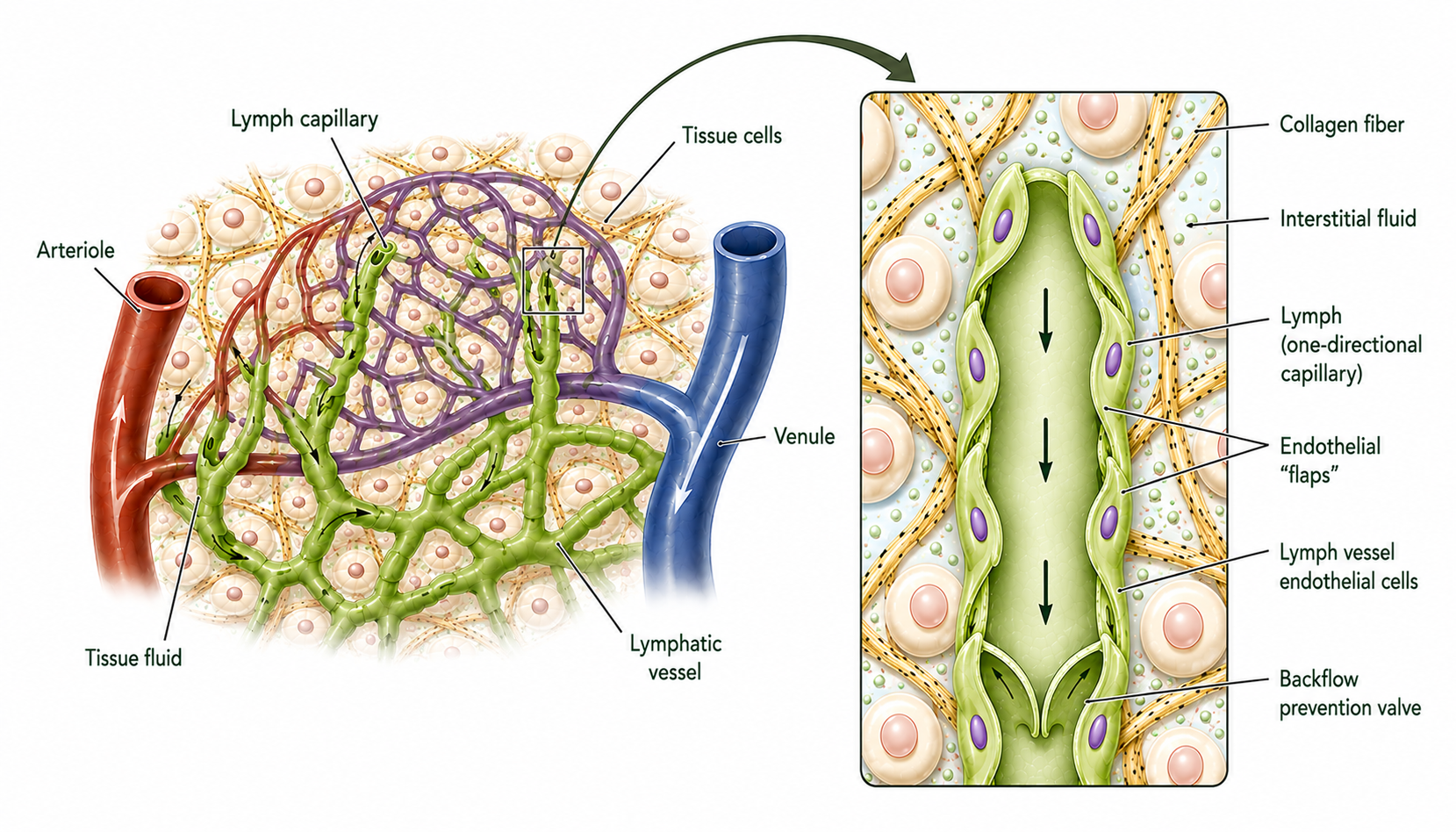
Lymph is about much more than swelling.
It is part of how your body maintains
its internal environment every day.
What Does
'Lymphatic Health'
Mean?
Lymphatic health exists on a spectrum. Every day, your lymphatic system responds to changing demands within your tissues.
A healthy system has the capacity to accommodate normal fluctuations—and even some increases in demand.
But that relationship can change.
LYMPHATIC LOAD
What is the system being asked to manage?
Think of lymphatic load as the demands being placed upon your lymphatic system.
Surgery, injury, inflammation, reduced mobility, connective tissue disorders, scarring, illness, medical treatments,
and other physical demands can
increase the amount or type of work required of the lymphatic system.
LYMPHATIC CAPACITY
What is the system currently able to manage?
Lymphatic capacity is the system’s ability
to transport the load placed upon it.
Capacity varies from person to person
and can change throughout life. Lymphatic development, hormones, genetics, surgery, injury, scarring, radiation, illness, reduced mobility,
and other factors may affect how effectively the system can transport fluid and other lymphatic material.
WHEN LOAD EXCEEDS CAPACITY
What happens when the system can't keep up?
Problems can develop when lymphatic load exceeds the system’s available capacity.
This imbalance may be temporary or persistent. Depending on the person and circumstances, tissue fluid may accumulate and changes such as swelling, heaviness, fullness, tightness, discomfort, or other signs of lymphatic congestion may occur.
What Can Affect
Lymphatic Health?
Lymphatic function does not exist in isolation.
Changes in health, mobility, inflammation, medical history, genetics,
and the demands placed on the body can all influence lymphatic load, capacity, or both.
Health & Inflammatory
• Autoimmune conditions
• allergies
• illness or infection
• digestive concerns
• inflammatory conditions
• connective tissue disorders
Medical Factors
• Surgery
• injury
• scarring
• radiation
• lymph-node procedures
• reduced mobility
Developmental Factors
• Genetics
• lymphatic development
• age
• medical history
• Lipedema
Life Experiences
• Swelling
• heaviness or fullness
• tissue tightness
• headaches or migraines
• sinus concerns
• digestive congestion
• fatigue
Manual Lymphatic Drainage
Manual Lymphatic Drainage Is More Than “Lymphatic Massage”
Lymphatic massage and Manual Lymphatic Drainage (MLD) are often used interchangeably, but the training behind them can vary widely.
Lymphatic techniques may be taught in massage school, continuing education, or specialized MLD courses. While these can provide useful skills, the depth of education in lymphatic anatomy and physiology, contraindications, fluid pathways, edema, and clinical application can differ considerably.
CLT training takes this further, with extensive education in lymphatic disorders and individualized clinical application. Pressure, direction, rhythm, sequence, and where fluid is directed all matter.
For general wellness, basic lymphatic techniques may be appropriate. For lymphedema, lipedema, post-surgical recovery, persistent swelling, or more complex wellness needs, more comprehensive MLD training and clinical experience may be especially valuable.

When Might Lymphatic Care Be Helpful?
Lymphatic care may be helpful when the body is managing:
increased lymphatic load, reduced transport capacity, or
changes in fluid movement.
These changes may occur following surgery, illness, injury,
medical treatment, or as part of an ongoing health condition.
People may seek lymphatic care for support with:
Lymphedema & Swelling
• Lymphedema
• Persistent or recurring swelling
• Heaviness, fullness, or tissue tightness
• Changes in fluid movement or tissue comfort
Surgery & Medical Care
• Before and after surgery
• Lymph-node removal or procedures
• Radiation or cancer treatment
• Scar tissue and changes following medical procedures
Head, Neck & Upper Body
• Dental or oral procedures
• Sinus or facial congestion
• Headaches or migraines
• Breast, chest, or underarm concerns
Overall Health & Wellness
• Injury, inflammation, or reduced mobility
• Digestive or skin concerns
• Autoimmune or inflammatory conditions
• General lymphatic health and wellness support
Not every symptom or health concern is caused by the lymphatic system.
Individual circumstances matter. Understanding what is contributing to
increased lymphatic demand — and what the system is currently able to manage,
helps determine whether lymphatic care may be appropriate.
A Clinical, Whole-Person Approach to
Lymphatic Care
Lymphatic care is not
one – size – fits – all.
Effective treatment begins with
understanding the individual—
your health history, symptoms,
medical care, movement,
tissue changes, and the demands currently
being placed on your lymphatic system.
At NM Wellness, Lymphatics, & Rehabilitation, lymphatic care is informed
by more than three decades of experience
across rehabilitation,
Occupational Therapy, Massage Therapy, Athletic Training, and specialized lymphatic treatment.
Treatment may include Manual Lymphatic Drainage, education, movement, breathing,
positioning, compression strategies when appropriate, and practical self-care tools designed around your individual needs.
The goal is not just simply to “move lymph.”
It is to understand what your body is managing, support the pathways available to it, and help you become an informed participant in your own care.
Understanding
Changes
Everything.
Effective lymphatic care is more than knowing:
how to perform Manual Lymphatic Drainage
how to perform Manual Lymphatic Drainage
Tools, knowledge,
& technique matter.
As does clinical reasoning,
to consider: why the lymphatic load may have changed,
what the system currently has the capacity to manage,
what pathways are available, and which
interventions are appropriate for the individual.
Effective care requires more than
pulling these things together —
it requires understanding which approach best
fits the individual, how to apply it, and why.
The lymphatic system does not function independently from the rest of the body.
Appropriate care requires understanding anatomy and physiology, tissue changes, medical and surgical history, movement and mobility, inflammation, healing, and the body’s available lymphatic pathways.
That means asking more than,
“Where is the swelling?” or “Where does it hurt?”
Clinical reasoning considers why the lymphatic load may have changed, what the system currently has the capacity to manage, what pathways are available, and which interventions are appropriate for the individual.
This is where Patricia’s multidisciplinary background matters. More than three decades of experience across rehabilitation, Occupational Therapy, Athletic Training, Massage Therapy, and specialized lymphatic care inform how each person’s presentation is evaluated and treated.
Knowing what to do and having tools is important.
Understanding why, when, where, and how to apply it all —
is what truly customizes individual care.
Lymphatic HealthCare in Albuquerque, New Mexico
NM Wellness, Lymphatics, & Rehabilitation
provides individualized lymphatic care in
Albuquerque, New Mexico
for people navigating lymphedema, swelling, surgical recovery, changes in tissue or fluid movement,
and other health concerns that may benefit from lymphatic support.
Care begins by looking at the whole picture—
not simply where symptoms are occurring.
Your health history, medical care, mobility,
tissue changes, lymphatic load,
available transport capacity, and individual goals all help guide what care may be appropriate.
Treatment may include Manual Lymphatic Drainage, education, movement, breathing, positioning, compression strategies when appropriate, and
practical tools to help you better understand and participate in your own care.
You do not need to know whether your lymphatic system is the problem before you come in.
Part of skilled care is helping determine what may
be contributing to what you are experiencing and whether lymphatic treatment is appropriate.
Wondering Whether
Lymphatic Care
May Be Right for You?
Whether you are navigating a diagnosed lymphatic condition,
recovering from surgery or medical treatment,
experiencing changes in swelling or tissue comfort,
or simply trying to better understand what your body is managing,
let’s begin with a conversation.
Phone
(505) 433-1272
Location
2501 Rio Grande Blvd NW
ALIGN THERAPY CENTER
Albuquerque, NM 87104