
Animal Lymphatic Health
Lymphatic Health
isn't
just for humans.
Every mammal has a lymphatic system—and just like ours, an animal’s lymphatic system plays an essential role in fluid balance, immune function, tissue health, and recovery.
My fascination with lymphatics has never stopped at our own species. Animals can experience swelling, tissue changes, injury, surgical recovery, scarring, and changes in lymphatic function too — and understanding
their lymphatic anatomy opens another fascinating window into how beautifully
this system is designed.
Same System.
Different Bodies.
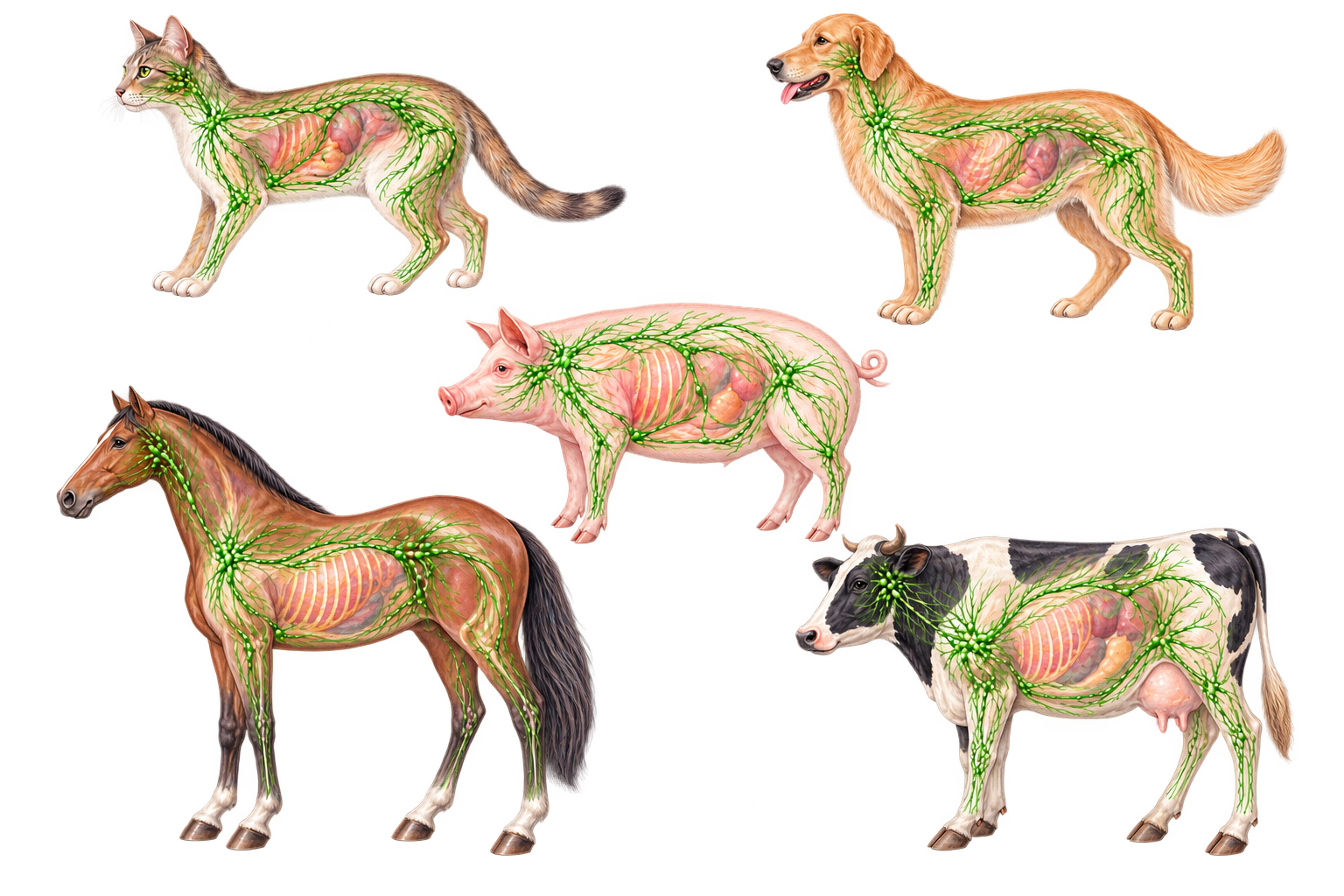
From a house cat to a thousand-pound horse, the scale and anatomy may change —
but the fundamental job remains remarkably familiar:
collect excess fluid and proteins from the tissues, transport lymph through vessels and lymph nodes, participate in immune surveillance, and ultimately return fluid to circulation.
When Might Lymphatic Support
Be Considered as Part of an Animal's Care?
Just as with people, there are circumstances in which lymphatic support may be considered
as part of an animal’s broader care and recovery under appropriate veterinary direction.
An animal’s health concerns should first be evaluated by a veterinarian,
who can determine whether lymphatic or other supportive care may be appropriate.
Depending on the animal and their circumstances, lymphatic support may have a role in a wide range of situations, including:
Recovery & Healing
• Post-surgical swelling
• Injury or trauma
• Localized edema
• Wound/tissue recovery
• Dental/oral procedures
• Spay/neuter or other surgical recovery
• Bee stings, bites, or localized reactions
• Post-illness recovery
• Following infection or inflammation
Tissue, Mobility
& Whole-Body Support
• Scar/tissue changes
• Mobility-related concerns
• Joint stiffness and reduced movement
• Skin and coat concerns
• Digestive complications
• Exercise, performance, and recovery support
• Reduced activity or convalescence
Lymphatic, Immune &
Regulatory Support
• Lymphatic conditions
• Persistent/recurrent swelling
• Allergies & sensitivities
• Skin irritation or recurring skin issues
• Eye-area problems
• Immune-system challenges
• Stress, anxiety, or behavior changes
• Chronic inflammatory conditions
Care Requires Knowledge
Manual Lymphatic Drainage is gentle, rhythmic, and anatomically directed.
Effective care requires an understanding of lymphatic anatomy and physiology,
appropriate pressure, direction, sequence, and — especially with animals —
the health circumstances of the
individual receiving care.
New or unexplained swelling, illness, injury, infection, or significant changes
in an animal’s health should be appropriately evaluated by a veterinarian. Lymphatic support is complementary to veterinary care;
it does not replace veterinary diagnosis or treatment.
In New Mexico, hands-on therapeutic treatment of animals by a non-veterinarian is subject to veterinary supervision requirements.
A Fascinating Extension of Lymphatic Health
While most of my work is with humans, my interest in lymphatic health has never stopped
at the edge of our species. Exploring animal lymphatics offers another remarkable
perspective on the same principles I work with every day — fluid movement,
tissue health, recovery, and the interconnected nature of living systems.
Animal lymphatic information shared here is educational and is not a substitute
for veterinary evaluation, diagnosis, or treatment.
Phone
(505) 433-1272
Location
2501 Rio Grande Blvd NW
ALIGN THERAPY CENTER
Albuquerque, NM 87104