
Lipedema
The Disease Too Often Called Fat
Lipedema Is Not Simply
a Matter of Weight
Lipedema is a chronic condition involving abnormal, disproportionate accumulation and changes in subcutaneous adipose and connective tissue, most commonly affecting the legs and sometimes the arms. It occurs predominantly in women and is frequently accompanied by pain, tenderness, heaviness, easy bruising, and changes in mobility and quality of life.
It is also frequently misunderstood, misidentified, or missed altogether.
For many people, years of being told to lose weight, exercise more, or simply accept the shape of their body have obscured something important: Lipedema is a disease, not a failure of willpower.
What Does Lipedema
Look and Feel Like?
- Disproportionate, usually symmetrical tissue distribution
- Painful or tender tissue with aching, heaviness or pressure sensitivity
- Easy bruising
- Feet and hands are often spared, sometimes creating a cuff at the ankle or wrist
- Nodular or fibrotic tissue changes
- Honeycomb or cellulite-like skin texture as tissue changes progress. Stage 2 is often described as uneven, dimpled, wavy or peau d orange (orange-peel) skin; older descriptions have also used the not-so-affectionate term mattress-like skin.
- Swelling may also be present
- Mobility and joint concerns, including the effects of hypermobile joints
This Is Not Simply Obesity
People with lipedema can have obesity. People with lipedema can also not have obesity. They are not the same condition.
Lipedema-affected tissue does not necessarily respond to calorie restriction and exercise in the same way unaffected adipose tissue does. A person may lose weight from the face, torso or other areas while the characteristic disproportion of affected limbs remains. Being unable to substantially change lipedema-affected tissue through conventional weight-loss efforts is not evidence of laziness, noncompliance or lack of effort. Nutrition, metabolic health, movement and healthy body composition can matter, but just lose weight is not an adequate treatment plan for lipedema.
Hormones Matter
Many women describe periods when their lipedema seems to flare, accelerate or become considerably more noticeable, with increased pain, tenderness, heaviness, swelling or changes in tissue and body size. These changes are particularly associated with major hormonal transitions including puberty, pregnancy and menopause. Current research suggests an important hormonal influence, although the exact role of estrogen and other hormonal mechanisms has not yet been completely established.
Something changes hormonally –
the body changes with it.
Stages of Lipedema
Stage describes tissue appearance,
not how much someone hurts.
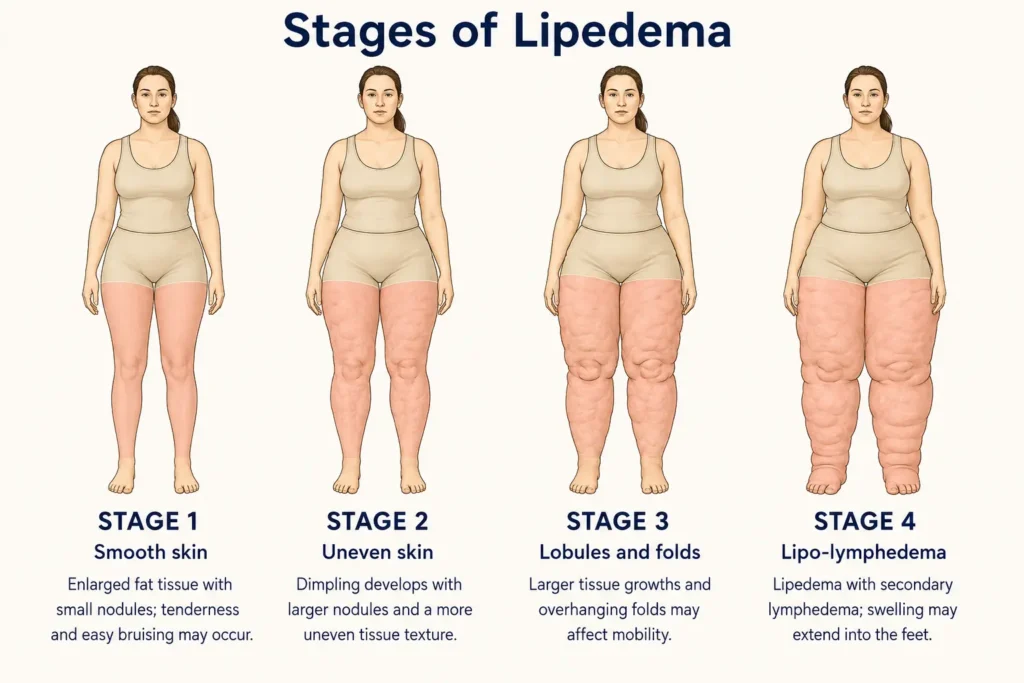
Stage 1: Skin generally remains smooth while enlarged subcutaneous tissue may contain small palpable nodules.
Stage 2: The skin becomes increasingly uneven, with indentations, dimpling, a wavy or orange-peel appearance, and more noticeable nodular or fibrotic tissue. This is where the honeycomb, cellulite-like or historically termed mattress-like presentation may become especially apparent.
Stage 3: More substantial tissue enlargement, fibrosis and contour changes may develop, including larger lobules or overhangs that can affect mobility and function.
Important: Lipedema does not inevitably progress from one stage to another. Current Lipedema Foundation guidance uses Stages 1–3. What was historically called Stage 4 is better described as Lip/Lymphedema, or lipolymphedema when lymphedema is also present.
Types of Lipedema
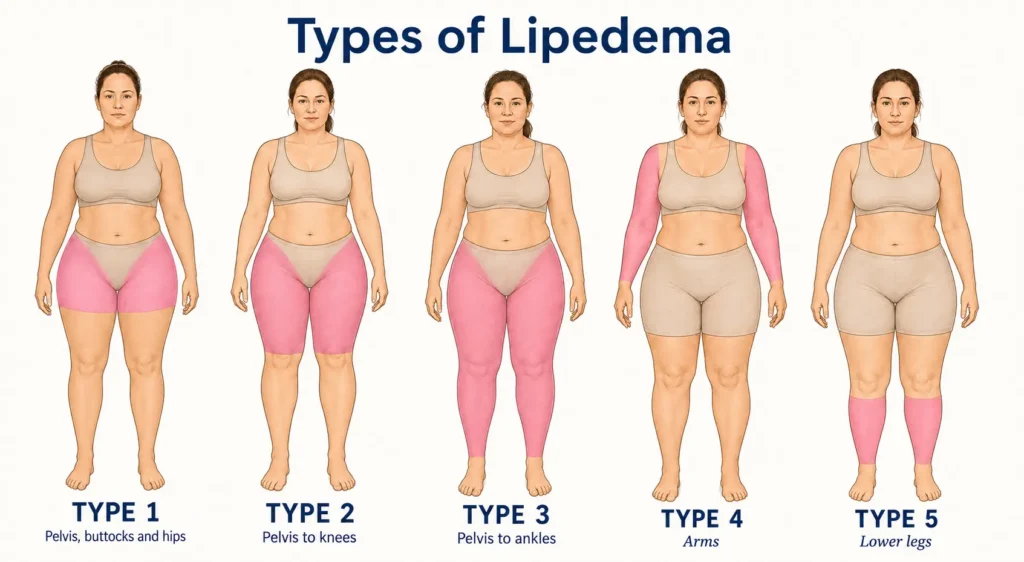
While stage describes tissue morphology, type describes where lipedema tissue is distributed. Distribution patterns can help with recognition, but they do not tell us how much pain, impairment or treatment need someone experiences. Commonly described patterns range from the hips and buttocks through varying portions of the legs; the arms may also be involved.
Connective Tissue, Hypermobility and Lipedema
Lipedema is not just about adipose tissue. Research continues to examine the role of connective tissue, and joint hypermobility appears more frequently among some people with lipedema. Possible associations with hypermobility spectrum disorders, including conditions such as Ehlers-Danlos syndrome (EDS), remain an area of investigation rather than an established feature of every person with lipedema.
Pain, joint stability, muscle function, movement patterns, tissue support and mobility can all influence care. Hypermobility, altered mechanics, pain and tissue distribution can also place additional demands on the hips, knees, ankles and feet. For some people with lipedema, orthopedic problems eventually become significant enough that hip or knee replacement may be considered. Some patients are then told they must first lose a specific amount of weight or reach a particular BMI. Surgical risk related to body size deserves individualized medical consideration, but BMI can be an imperfect measurement in someone whose disease itself creates disproportionate accumulation of tissue in the extremities. Simply telling someone with lipedema to lose the weight and come back may overlook an important part of her clinical picture. Lipedema deserves to be part of the orthopedic conversation. The whole person matters, not simply the size of a limb.
Lipedema and the
Lymphatic System
Lipedema and lymphedema are not the same disease, but the lymphatic system still matters. Changes within adipose and connective tissue, fluid dynamics, mobility, inflammation, vascular function and tissue load can interact with fluid balance. When clinically significant lymphedema is present with lipedema, this may be described as lipolymphedema.
Lipedema vs. Lymphedema
LIPEDEMA: Usually bilateral and symmetrical; disproportionate adipose/connective tissue; feet commonly spared; pain/tenderness and easy bruising common; strong female predominance; hormonal transitions frequently associated; may coexist with lymphedema.
LYMPHEDEMA: May be unilateral or asymmetrical; results from impaired lymphatic transport relative to lymphatic load; can involve feet or hands; may occur in any sex; can be primary/genetic or secondary; long-standing edema can produce fibrosis and tissue changes.
Pain Deserves Attention
Pain is not an incidental complaint in lipedema. It is one of its defining burdens. Tissue may be tender to pressure or touch, ache spontaneously, feel heavy, or make movement uncomfortable.
A Note About Cannabinoids and CBD
In my clinical experience, some individuals with painful lipedema tissue have reported significant relief with cannabinoid/CBD products, including topical preparations.
Research specifically evaluating cannabinoids for lipedema-related pain remains limited, so these products should be understood as an individualized complementary option rather than an established treatment for lipedema itself. Individuals interested in cannabinoid products should consider health history, medications, product quality, route of use and applicable laws, and consult an appropriate healthcare professional when needed.
Pain relief matters.
Nutrition May Matter, Too
Lipedema is not caused by eating the wrong foods. At the same time, nutrition can influence metabolic health, inflammation, weight management and symptoms. Current guidance discusses anti-inflammatory Mediterranean and ketogenic or low-carbohydrate approaches as potential tools. There is no single diet appropriate for everyone.
Inflammation and Emerging Connections
Researchers continue to explore relationships among lipedema, inflammation, connective-tissue differences, metabolic health, vascular changes, hormonal mechanisms and immune activity. Some people also report overlapping conditions or symptom patterns involving mast-cell activity, hypermobility or other inflammatory concerns. These relationships are still being investigated and should not be interpreted to mean that lipedema is an autoimmune or mast-cell disease.
Bodies rarely organize themselves according to our diagnostic boxes.
How Is Lipedema Managed?
There is no single treatment plan appropriate for everyone. Conservative management may include Manual Lymphatic Drainage (MLD), Complete Decongestive Therapy (CDT), compression, movement and individualized exercise, skin and tissue care, self-management education, pain-management strategies, nutrition and metabolic-health support, attention to mobility and joint stability, and medical or surgical consultation when appropriate.
CDT commonly incorporates compression, MLD, decongestive exercise, skin care and education/self-management. Not every person requires every component.
MLD does not remove lipedema adipose tissue. Its role may instead relate to lymphatic support, fluid management where appropriate, nervous-system effects, tissue comfort and symptom management.
Where NM Wellness,
Lymph, & Rehab Fits
At NM Wellness, Lymphatics, & Rehabilitation, care is not based simply on the name of a diagnosis.
We look at your tissues, your lymphatic system, your pain, your movement, your health history, your function, and what you need help doing.
Care may incorporate Manual Lymphatic Drainage, components of Complete Decongestive Therapy, compression and self-management education, movement and functional considerations, and individualized strategies for supporting lymphatic and tissue health.
No referral is required to contact NMWLR or schedule care.
NMWLR provides individualized lipedema education and supportive lymphatic care in Albuquerque, New Mexico.
My Doctor Does Not Know Much About Lipedema
Unfortunately, you are not alone.
Lipedema remains underrecognized, and healthcare professionals may have received little or no formal education about identifying or managing it. There is currently no single laboratory or imaging test that confirms lipedema; diagnosis relies heavily on clinical history, characteristic tissue and body-distribution patterns, symptoms, physical examination, and consideration of other possible diagnoses.
That makes knowledgeable healthcare involvement valuable, but it can also leave patients doing far more self-advocacy than they expected. If weight or BMI is being used as a barrier to medically necessary care, it may be worth asking whether the healthcare team has considered lipedema, body-fat distribution, metabolic health and individualized surgical risk separately, rather than assuming that all body weight represents conventional obesity.
The Lipedema Foundation created a Clinicians Guide to help healthcare professionals with presentation, examination, patient history, treatment and referral considerations. You can bring the information with you.
You Deserve to Understand What Is Happening in Your Body
A diagnosis, or even the suspicion of one, can bring relief, grief, anger, validation, questions,
and sometimes years of experiences suddenly making more sense.
Understanding lipedema does not mean you suddenly have to do all the things.
It means you finally have better information from which to make decisions.
If you are wondering how lymphatic care might fit into your particular situation, we can begin there.